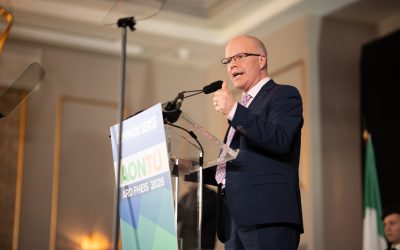
The Aontú Leader Peadar Tóibín TD today raised the issue of the promised Navan to Dublin rail line in the Dáil with the Minister for Public Expenditure during Leaders’ Questions. The Meath on Track group, of which Tóibín is chair, are having an urgent meeting in the Newgrange Hotel on 4th December at 7.30pm.
Speaking in the Dáil Deputy Tóibín said:
“This morning commuter traffic on the M3 going to Dublin was backed up to well inside county Meath. The journey for tens of thousands of people took two hours. Meath is the biggest commuter county in the country. Meath is the only county in the country where the majority of workers leave the county to go to work. 90,000 Meath people commute to work. 60,000 are forced to use cars for the lack of a rail line. Indeed, Navan is the largest town in the country without a rail line”.
Deputy Tóibín continued: “In 1994 Fianna Fáil’s Noel Dempsey promised to build a rail line between Navan to Dublin. The delivery date slipped and slipped. Finaly we were told that the rail line would be built by 2015. It never got built. I’m the chair of the Meath on Track Campaign. The people of Meath collected petitions and protested, and we were told in 2021 that the Navan to Dublin Rail Line would be resurrected. We were told that work would start by 2030, and the rail line would be built by 2036 at the latest. This promise to be honest, was met with derision in Meath. This promise was seen as horizon politics. People felt that the government was putting the project so far in the distance that it would never happen. 2036, the proposed delivery date is 42 years after the rail line was first promised by Fianna Fáil”.
“In 1862, the original Navan to Dublin Rail line was built in three years with picks and shovels. 42 years with all the technology that exists today and 3 years with picks and shovels in the 1860s. This week have heard that there is a new delay. The Railway Order for the project will now be submitted by the end of 2027, rather than in 2026 as originally planned. The glacial delivery of key infrastructure in this country is damaging the lives of hundreds of thousands of people. The economic cost of congestion in the Greater Dublin Area stood at €336 million in 2024. The Dept of Transport estimate that this will increase to €1.5 billion by 2040.
Research in 2023 from traffic data in Dublin ranked the capital, worst in Europe for both time and money wasted. The Dublin Transportation Office measured the average speed of cars nearly 20 years ago in Dublin city at 12km/h. This was slower than that of the horse-drawn carriages of the 19th century, which travelled at speeds of up to 16km/h. This government cannot build key infrastructure in a timely fashion. There are so many projects that are currently snarled up with major delays. Your government has created one of the slowest planning, permitting, licencing, tendering and judicial review systems in the EU. This is an infrastructure emergency all around the country. The government need to make a clear commitment to the rail line”.
“Simultaneously to this, the government are using a stick on drivers. Motor tax and VRT took in €1.9b last year. Motorists contributed to €4.1b of fuel taxes last year. Just in the last week the TII hiked up tolls on the M50 and the Port Tunnel, two pieces of infrastructure that the government owns. Drivers have already paid €2.2billion in M50 tolls on bridges that cost £53million pounds to build. Commuters have paid for these bridges multiples times over. Surely you can see how unfair it is to use the stick of extra costs on commuters without using the carrot of proper access to public transport. Commuters can pay up to €3000 on tolls every year to sit in traffic for hours without a public transport alternative. It is high time the government end the bureaucratic and red tape nightmare that has so many people stranded without key infrastructure”, concluded Tóibín.