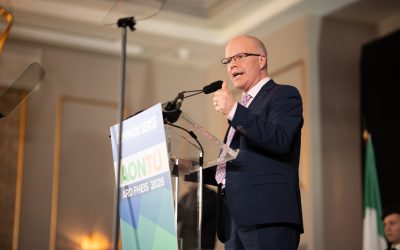
National communications director Larissa Nolan looks at Aontú in the news in the past seven days.
Cost-of-living pressures continued this week, with the announcement Electric Ireland is to hike its gas and electricity prices.
The company said it’s increasing electricity by 8% and gas by 7.7%, which amounts to a standard €11.52 a month on electricity and €9.73 a month on gas – or an extra €250 a year on a household bill. The rises will start in July and add more pain to hard-pressed householders.
There is a solution to this, according to Aontú leader Peadar Tóibín, who said the increases could be offset by ESB’s “supernormal profits.” Deputy Tóibín said: “The government could mitigate this €250 annual price rise, as Electric Ireland, the supply division of ESB, has a “profit buffer.”
He explained: “This company is making supernormal profits on behalf of the government and is rising prices on citizens who, in increasing numbers, cannot afford to pay.
“It’s a semi-state company that operates on the policy of the government of the land. It could mitigate as Electric Ireland has profits of €650m a year. You would save every domestic household €300 every year.
The announcement came on the same day it was revealed data centre pressures on the grid added an average €360 annually onto household bills.
“Electricity prices are already the highest in Europe, which we found out earlier this month. We’re paying €480 a year more than others in Europe. A total of 320,000 people are in energy arrears already as they cannot afford to pay.”
Consumers are also becoming increasingly frustrated with the Re-turn scheme.
Peadar Tóibín called Re-turn bosses before an Oireachtas committee saying it needs to reform or die.
Last week, he requested bosses of Ireland’s Deposit Return Scheme (DRS) to come before the Oireachtas Committee on Climate and the Environment and Energy.
He wants the state-mandated agency to answer questions about its environmental cost-benefits; its €500,000 clean-up costs, its financial transparency, and to explain why it is not moving towards modern alternatives such as a digital DRS, a more inclusive model.
He said: “The Re-turn scheme costing Dublin City Council half a million a year to tackle is the latest in a long line of revelations about the shambolic scheme. It has problems from everything from health and safety concerns to retailers’ woes to members of the public frustrated with filthy and finicky reverse vending machines. The government needs to reform or end this shambolic scheme.”
“This is a company that retained €100million of customers’ unredeemed deposits in 2024. It’s a tax in all but name, but it’s not going back into the public purse. It goes back to a private company, and we don’t know the salary of the CEO.”
One question for Re-turn is how a Fine Gael councillor is lobbying the Fine Gael Minister with responsibility for the scheme to get rid of the 23% VAT on the unredeemed bottles and cans.
Dun Laoghaire Rathdown councillor Eoin O’Driscoll is public and regulatory affairs manager for Re-turn, a job he took up in March. Records show he lobbied Minister Alan Dillon about the VAT issue.
Peadar Tóibín described it as “a shocking conflict of interest.” He said: “Here we have Fine Gael on both sides of the lobbying equation.
“We have a Fine Gael elected representative lobbying a Fine Gael minister, essentially to take these millions in VAT for themselves and to take it out of state services like schools and roads and hospitals and welfare. It’s the definition of a conflict of interest.”
Looking forward, next month sees the start of the EU MIgration Pact, which Peadar Tóibín says is “a big mistake.”
The Meath West TD said: “It’s a mistake, because Ireland is unique. It fails to account for our open border with the North.”
Toíbín says the EU-wide reform – which starts on June 12 – is flawed because it does not consider how 80% of international protection applicants come in from over the border.
“The “EU migration pact is bad for Ireland. It outsources decisions on cost and numbers coming here, and locks us into those decisions.
“It does nothing about the 80% of people coming here from Britain through the north.
“Aontú believes in a stricter system, a compassionate one that still allows people to enter the country if they are fleeing a war or violence. But there’s no doubt that there’s too much pressure on public services particularly in relation to the supply of houses.”
The week was overshadowed with news of the killing of IPAS mother Masuma Sohrabi in Galway.
The Iranian woman, 31, had been in Ireland since 2024 and was living in Waterloo House in Clifden.
She had been trapped in a violent relationship and had gone to gardai and the courts before her body was found on Thursday morning.
Senator Sarah O’Reilly has long been calling for a better response to domestic violence in Ireland, which is directly related to femicide.
On Masuma’s death and subsequent murder probe, Senator O’Reilly said: “Women in IPAS centres face a heightened risk of gender based violence.
“A Doras report last year confirmed these women were a high-risk group due to issues of privacy and stigma and lack of supports.
“If we are welcoming women to Ireland and promising them refuge, we need a framework to ensure their safety, as far as possible.
“This is a terrible case where a woman came here for asylum and ended up being brutally killed, leaving two children without a mother.
“We are yet to hear the full details of what happened before this and if there was anything more that should have been done.”
Aontú’s Mayo TD Paul Lawless took advantage of the fine weather to invite a deserving and timely group to Leinster House. Of course, the sun always comes out just in time for the Laving Cert to start, and this year was no exception.
Deputy Lawless hosted a briefing in the Oireachtas with Dyslexia Ireland on the need to reform Reasonable Accommodations in Certificate Examinations (RACE) system.
He said: “A review is currently underway, and we need to make sure it delivers meaningful change.
“Students with dyslexia often process information differently. The current system has serious barriers including rigid eligibility cut-offs, inadequate extra time, and technology that isn’t fit for purpose.
Reform must deliver fairer eligibility criteria, time accommodations, access to assistive technology, and earlier decisions so students can plan.”
Fógra:
We’re moving to a monthly update from here on, so expect the next digest at the end of June.