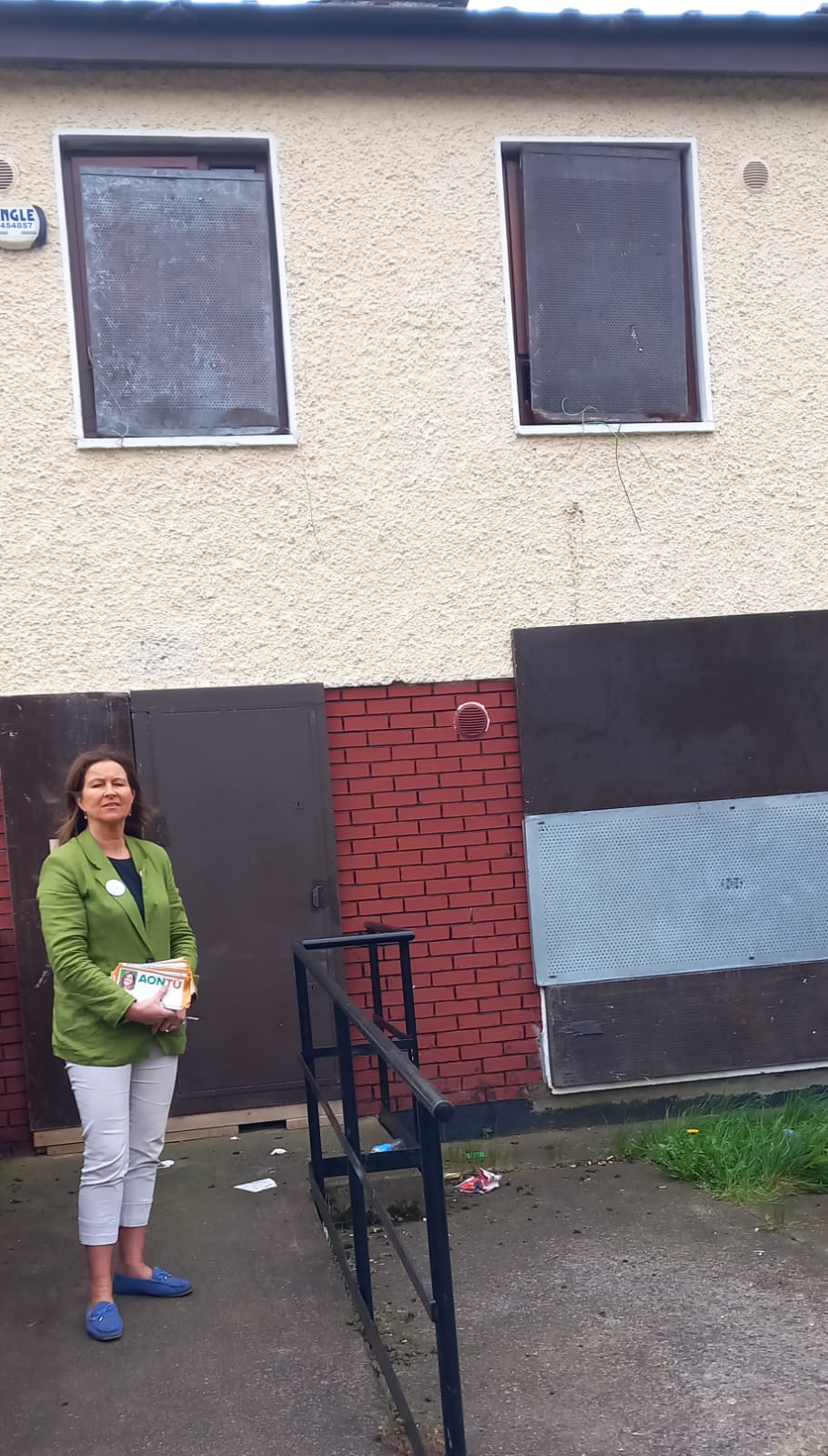
Housing Crisis
Action needed to address our National Housing Emergency
Ireland has the 4th highest number of homeless people in Europe.
The housing crisis has defined the last decade of Irish politics and threatens to define the future of our nation for years to come. Up to a million people are being forced to live in misery due to mortgage distress, homelessness, waiting lists of many years and/or grossly unaffordable rents and mortgages.
It has been far too long since any Irish government has lived up to their responsibilities. The record of at least three successive governments on housing and homelessness in Ireland has been nothing short of shameful. There are 14,486 people officially registered as homeless in this state. That’s 10,067 adults and 4,419 children are accessing emergency accommodation in Ireland.
This is the equivalent of everyone who lives Killarney, Co. Kerry homeless. This is equivalent to 180 classrooms of children, homeless in Ireland at the moment. Let that sink in. These figures are getting worse every day under the FF/FG/Green government. These figures do not count those who are sleeping rough or those who are sleeping on couches with friends and families.
Empty homes
There are 4,000 empty Local Authority Homes, each empty for on average 8 months. Aontú will turn around empty local authority homes for re-let within 2 months. The private sector, in contrast, are turning around empty homes within 3 weeks. We will reduce the turn around renovation spec so that properties are turned around in no longer than 1 month.
Local authorities currently have enforcement powers in relation to empty homes, such as the power to issue Compulsory Purchase Orders. However, the use of these powers has been of limited use given it does not guarantee a property is brought back into use.
We will utilise CPO’s for properties that have been empty for longer than 5 years. Refurbishment grants are not being managed properly by the Government. The Minister for Housing has confirmed to Aontú that a mere €4.3 million has been spent through the vacant property refurbishment grant since it was launched in July 2022. According to our research, only five of these are being processed and approved per month. At that rate, it would take 1,600 years to refurbish all empty homes and bring them back into use.
- Aontú in government will provide 8,000 vacant home grants of up to €70,000 each costing the exchequer €560m a year.
- Aontú will significantly reduce the bureaucracy and red tape surrounding the drawing down of this funding.
- Aontú will provide a similar grant of up to €30,000 for refurbishment of above the shops accommodation. This will cost €60m.
- We will reduce the regulation that is stopping so many people living in the centre of towns.
Social and Affordable Housing
An increase in the supply of housing is the key to resolving the housing crisis. Firstly, the supply of social and affordable housing needs to be increased. In the 30s, the 50s, and the 80s, in tough economic times, social and affordable housing was built at far higher rates. Last year, the number of people living in homelessness exceeded the number of social housing units built.
Out of a target of 9,100 new build social homes, just 8,100 were delivered last year. Last year the target for affordable purchase and cost rental homes was 5,500 homes. 1,500 affordable purchase and cost rental homes were delivered.
- We will build 15,000 social and affordable homes a year for the life of the next Dáil.
- We need to ensure that the Traveller Accommodation Budgets are spent appropriately and fully by each Local Authority.
- Aontú will create, develop and implement an immediate plan to renovate/rejuvenate the interiors of social housing throughout the country.
- Those in rural areas who own land, but cannot afford to build, or whose current housing is run down, should be permitted to sign over a site to the local authority on which a social house can be built and rented back to them.
- Aontú proposes a carrot and stick approach to mandate utilisation of the land – grant funding and vacant house tax to get the 1 in 33 empty homes in the state back into use.
Rental Crisis
The average rent in Dublin is more than €2,390 a month. Annually this is a full €3,000 more than the before-tax-income of a person working full time on the minimum wage. The HAP Support scheme can’t keep up with the rate of rent increases.
Young couples and families are moving back in with their parents for years to try cobble together a deposit. People are having to live further outside of Dublin to afford a home. This is adding to the urban sprawl, commuting hell and air pollution.
Aontú proposes a number of reforms to begin solving the rental crisis:
- Ensure the 2% Rent Pressure Zone (RPZ) cap is adhered to.
- Ease “over shop” accommodation regulation to allow for empty commercial properties to be used to accommodate families.
- We will introduce a no-fault eviction ban for tenants.
When the ban was debated in the Dáil, we argued for the need to offer specific protections against eviction for people who have a disability, or who are suffering from cancer or another severe illness, and also for tenants who are pregnant or who have given birth to a child within the last three years and people aged over 65 years.
The reality is that there are many local authorities around the country where there is not a single available emergency homeless accommodation bed. Government parties voted against our proposal.
Home Ownership and Construction
The Government have destroyed the ambition of millions of people to be able to own their own home. The myth of an affordable home has been the lie that they have built their disastrous housing policy on, whilst thousands of Irish people remain homeless. In 2023, the average cost of a home under the Affordable Housing Fund was €266,869 – anything but affordable.
Successive Governments have and continue to give the impression that they are in control of the number of homes / housing units being built each year. The reality is that since the 2008- 2010 economic crash, the Government has relied almost exclusively on a near monopoly of private developers and vulture funds to build houses and apartments.
As an example, there are over half a million young people still living in their parents’ homes. Over the last 10 years, this policy has failed abysmally and will continue to fail unless the Government recognises that they are not in control and decide to directly compete with the current monopoly, who can decide where to build, when to build and charge whatever they can to maximise their profits.
- Aontú will end the eternal regulation change. The current housing Minister has changed building regulation several times. As a result, many builders expect further change which will allow more units to be achieved per site. This has the effect of slowing down the building of houses.
- Aontú want to engage engineers and architects to design housing schemes and invite tenders from house building firms or contractors of all sizes.
- Aontú will seek to re-zone land across the country for housing, and seek to control the cost of units through the public building process.
- Aontú seeks to implement policies which will end the cosy relationship between vulture funds, developers and the government parties. The housing policy of the Irish government should not give a blank cheque to international investors and pit young families against vulture funds.
- Aontú will introduce amendments to EU law to delete advantages that FF/FG give to international investment vehicles which allows them a competitive advantage over families seeking a home.
- Aontú will zero rate construction materials for the period of the next Dáil to lower the cost of building homes.
- Aontú will reduce HBFI rates from 13% to 5% and subsidise the connection fees of utilities for new homes. This will reduce the cost of building homes and make projects more viable. These proposals would reduce the price of a house by €55,000 homes.
- Aontú will reform and speed up the planning permission process. We will do this by recruiting more planners by providing proper pay and conditions for planners.
We will end land bank speculation. We have already introduced a Bill into the Dail that would end tax advantages for predatory Real Estate Investment Trusts or (REITs). We have also introduced a Bill into the Dáil that would end Air bnb operating in in large towns and cities for an emergency period of 2 years.
Through these priorities, we believe the Government will be competing with, rather than relying on, private developers to meet the country’s housing needs. This competition will also likely lead to reduced profits for private developers, particularly as the supply of new housing greatly improves.
Homelessness
There were 400 homeless deaths in Dublin over the last five years. The recording of homeless deaths is confined to Dublin. What does it say about the broken and callous nature of our political system that we cannot even figure out how many have died on the streets of Ireland?
Over €2.1bn has been spent by Local Authorities on services for households experiencing homelessness between 2009-2022. Most of this money has gone to commercial hotels and B&Bs. Our proposal repurposes that funding towards emergency accommodation to be allocated to housing associations and local authorities.
- Aontú will ensure that there is a standardised reporting of homeless deaths in each County.
- Aontú will ensure better communication between various State entities and wrap around supports for homeless people in terms of the prison service, social work, mental health and addiction services.
Tenants’ Rights
Due to the dysfunction within the market and the lack of tenants’ rights within the law, many tenants are living in poor conditions, paying exorbitant rents and suffering due to the precarious nature of contracts.
Indeed, most of the people presenting as homeless are coming from the private rental sector. A number of reforms in this sector will stem this human tide. Many small Landlords around the country have found themselves landlords by circumstance, with high mortgages and difficulties with a minority of tenants who do not fulfil their contracts or their obligations.
Greater security of tenure must be provided. Tenancies of indefinite duration must be provided for and the grounds of sale should be removed from the Residential Tenancies Act.
“Buy to Let” landlords who achieved tax breaks from the state should be prevented from issuing vacant possession “Notices to Quit”.
We need the State to increase the number purchases of ‘tenants in situ’ house sales in Ireland. It should be made easier to remove tenants who wilfully damage property or do not live up to their agreed tenancy agreement.
Infrastructural Development
Human resources and Infrastructure are key to the provision of homes. This government has completely ignored the provision of infrastructure over the last 10 years. For the majority of the last 10 years Ireland has been second last in the EU for expenditure on infrastructure as a result tens of thousands of home builds are blocked for the want of water and waste water.
Aontú in government would invest €3.5bn in the provision of clean and wastewater next year making it possible to build tens of thousands of new homes. Operation Shamrock There are hundreds of thousands of construction workers building houses at the moment.
The problem is up to half of these are building houses in Australia and Canada.
Aontú will launch Operation Shamrock to attract key Irish construction workers who have moved abroad to come home. This will include a relocation package of €5,000 in vouchers to spend on flights, accommodation etc for workers who have left Ireland more than 2 years ago. We would also provide a €10,000 tax credit for these specific workers spread over 3 years. The worker would have to remain within the Irish state working in the sector for 4 years after moving home. For 10,000 staff this would cost €100m. Aontú will build accommodation for returning workers in a speedy fashion under Class 17 of the Exempt Development Regulations. This would cut down the time of build radically. It would cost €350m.
Aontú will also improve workforce planning in radically increase the number of construction apprentices from 1,500 a year to 3,000 a year.
Student Accommodation
Right now, in Ireland students are crying out for accommodation. Student towns and cities have hostels full of students, or students commuting long distances from the home places. This in untenable.
We’ve seen situations where students are handing out leaflets on main streets looking for accommodation.
- Aontú seek to end the interference of the EU on the ability of the Irish Government to regulate Air BnB’s. At present students are living in hostels while tourists are in houses right across the country. We will ensure than no vacant property in a student town is being used as an Air BnB, we will ban them by way of legislation.
- Aontú will ensure that basic, affordable, non-extravagant student accommodation is made available for students on campus, and we will ensure value for money in this process.
Defective Blocks
We have a crisis of defective buildings all across the country, and all due to decisions not to enforce standards in the building industry, a clear case of negligence on the part of our political classes and permanent government.
While all these leave families and family businesses facing unaffordable costs, for which the government must accept liability, the most dishonest of these is where the government actually took time in the Dáil to enact regulations, pretending to the public that they could rely on those regulations, and then chose not to actually provide the resources to do the work. This is the case with substandard building materials which have been found across at least 16 counties of Ireland.
The government, political and permanent, has done its utmost to run away from this problem, such as making deliberate decisions not to do full scientific laboratory investigations.
This has resulted in thousands young families and others, already burdened with expensive mortgages, facing complete rebuilding of their homes when these billions in total costs could have been avoided for less than the cost of new windows for one house. It has taken the private initiative of the victims themselves to investigate and find the source of the problem and the authorities are still working on updating regulations, even though the problem is known and has been acted upon in many other countries.
The proper resources have still not been provided to enforce even the current regulations, with the excuse from the Housing Minister that there will be new building quality legislation next year. But he has given no guarantee that there will actually be a budget for enforcement of these new regulations either.
Fire certification of apartment blocks remains a function of the private sector, where the certifier is paid by the developer. While we may have some confidence in the professional liability of the certifiers, we believe that this should be a function of a properly resourced public buildings control office, as is the case in other countries.
Aontú has signed up to the People’s Document of the Donegal Mica Action Group, which lays out what is required for all victims throughout the country and what is required to stop problems like this now and in the future. While the financial and psychological harms to home-owning families are front and centre, this failure of governance has caused immense harm to community buildings, accommodation for renters, family farms and businesses and these need to be addressed as well.
100% Redress for the financial costs is the starting point along with technical and psychological support for victims who are not familiar with the technical issues and have to face the terrible psychological burden of losing their forever homes.
The operation of the current scheme represents a hostile environment for victims, with the government more concerned to evade responsibility than to help victims. We believe that the necessary resources are not available in local councils or in the regional health service and these extra resources must be made available by central government to support victims locally in every stage from suspect building through to final completion of any rebuild.
The level of necessary remediation must be based on the scientific evidence and not on direction from Merrion Street. In the case of defective blocks and defective aggregate in foundations, where international experts say total demolition and rebuild is the proper option, then that must be the case.
There needs to be flexibility in planning to allow temporary accommodation on site where needed, or to downsize or change building technology where this can speed up building or reduce costs. Where aggregates or concrete products need to be used, the local council must be provided with full laboratory resources to ensure that all known deleterious materials, whether or not included in the relevant standards/regulations, are excluded.
Failure to do this could mean that we just have the same problem again in a few years’ time.