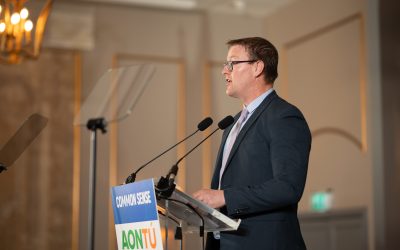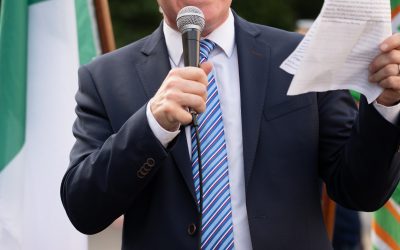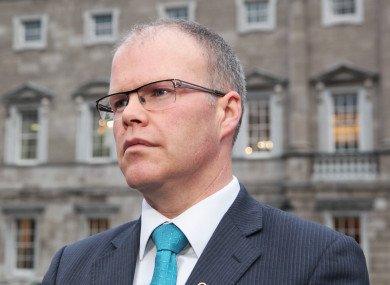
Aontú leader and Meath West TD Peadar Tóibín speaking at the Aontú Dáil debate on the unfolding Tariff crisis has said that the political establishment in Ireland has not taken the tariff war seriously. He stated:
“It is stunning that there has been no Dáil datable on the impending tariff disaster, until Aontú tabled a Private Members Bill to discuss it today. Think about it, the Dáil is debating this tariff war for the first time, the day that significant tariffs were imposed on many Irish businesses and workers”.
“Ireland is the most exposed country in the European Union to a United States tariff war. Ireland exported €223.8 billion of goods and services last year, one third of these exports, €72 billion, went to the US, of which €58 billion of this is made up of pharmaceuticals and chemicals. This is an enormous exposure. Ireland’s economic health is inextricably linked to our relationship with the US. Yet is only today that the Tánaiste is meeting with US Secretary of Commerce Howard Lutnick”.
“Ireland exported €81 billion to the EU in 2023. So despite Ireland being a member of the EU, our exports to the EU are only 12% more than our exports to the US. This is how integrated our economy is with the United States. Yet the there is no Oireachtas Committee on Trade, Employment, Finance or the Good Friday Agreement in existence”!
“There is no government preparation for supports for businesses or employees that will become collateral damage to the tariff war. There is no reset of enterprise policy to build indigenous enterprise to reduce medium to long term exposure. There is no leverage of our relationship with the US in order to bridge the gap between the US and the EU in terms of negotiations”.
“There is little material proof that Ireland is putting the brakes on the EU in terms of tariff retaliation which would be a fatal blow for many Irish businesses. The best form of retaliation from the EU should be no retaliation at the moment. The whole tariff crisis has been eclipsed in the Dail by chaos and dysfunction in recent weeks. There is an incredible lack of urgency for what is the biggest existential economic threat to Ireland since the banking crash”.
Motion re Protecting the Irish Economy against increasing Trade Tariffs
Body
That Dáil Éireann:
recognises that:
— Ireland is the most exposed country in the European Union (EU) to a United States (US) tariffs war, and while a reprieve has been given to the pharma sector, the landing zone on tariffs is still not known;
— a full-scale tariff war will affect Ireland disproportionately, and while Ireland exported €223.8 billion of goods and services last year, one third of these exports, €72 billion, went to the US, of which €58 billion of this is made up of pharmaceuticals and chemicals;
— Ireland is a small open economy, and a fall in international trade, precipitated by the increase in global tariffs, will hit Ireland hard;
— Ireland is potentially facing a fall in employment and job creation, leaving many indigenous businesses, especially in the agri-food sector and drinks sector, badly hit;
— corporation taxes are likely to fall, and future public spending is in real danger; and
— the all-Ireland economy and the Windsor Framework will face significant challenges with differing tariff regulations on each side of the border, and products with integrated North–South supply chains will face major difficulties;
acknowledges that:
— Ireland’s economy is unbalanced, and Ireland is heavily reliant on the foreign direct investment (FDI) sector and has a small, weak indigenous enterprise sector;
— Ireland has become a very expensive location to do business and has the most expensive net electricity prices in the EU;
— Irish firms seeking to grow are often located outside of Ireland; and
— Ireland has capacity shortages in many key infrastructure areas, from housing to transport to energy; and
calls on the Government to:
— take a stronger and more direct role in negotiating with the US administration, as the stated objective of the US administration is to reduce the perceived trade imbalance between the US and the EU, and seek if this can be addressed while protecting the Irish economy;
— demand that the EU pursues a pragmatic policy of de-escalation;
— ensure that the EU does not make retaliatory tariff decisions that makes a target for the US of key Irish enterprise sectors;
— significantly increase Ireland’s diplomatic footprint in Washington DC, with the Republican Party in the US, and in the office of Permanent Representation of Ireland to the EU;
— develop Covid-19/Brexit magnitude supports for indigenous enterprise sectors that will be worst hit, providing export and market diversification supports, and provide increased grant funding for increased research, development and innovation;
— create sectoral taskforces to include relevant stakeholders, including employers and trade unions, and provide adequate income supports to workers who lose their jobs;
— continue to attract and support FDI, but also start to develop a stronger indigenous enterprise sector which is less mobile and less likely to move out of Ireland;
— reduce the reliance of corporation tax in Ireland’s enterprise policy by investing in other competitive advantages, such as transport, housing, communications, energy, water and education infrastructure;
— reduce input costs to businesses, such as electricity, property, banking, insurance, and other utility costs;
— review non-human resource regulation on indigenous enterprise, with a view to cutting unnecessary red tape and bureaucracy, which will simplify and speed up the planning process, and improve investment opportunities for growing Irish firms;
— create a better regional and spatial delivery of Enterprise Ireland and IDA Ireland investments; and
— reinstate the Oireachtas Joint Committees on Enterprise, Trade and Employment and on Finance, Public Expenditure and Reform, and Taoiseach immediately.