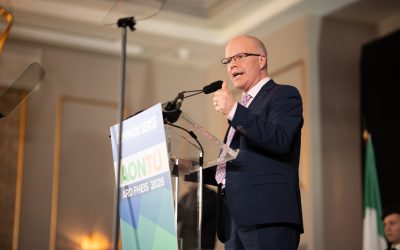
Aontú has decided not to bring a motion of no confidence before the Dáil next week.
Speaking today, Deputy Peadar Tóibín said:
“We announced the original motion in order to bring as much pressure as possible on the government to do the right thing for children with scoliosis. We believe we succeeded in achieving this, this week.
If we brought a motion of no confidence against the government next week, we would not be able to table another such motion for another 6 months. This would rob us of a key tool to pressure the government at a key juncture in the future. Motions of no confidence should be used sparingly. They should be timed to have maximum affect to achieve objectives. Running two, one week after another would not achieve that objective.
The responsibility is now on the government to provide a terms off the reference for the Inquiry that includes the statutory powers to compel people and papers. The responsibility is now on the government to agree a terms of reference with the families. The responsibility now is to reform the dysfunction within CHI and provide the necessary resources. We are putting the government on notice, that if they don’t achieve these objectives Aontú will table a motion of no confidence in the government within 6 months. We have come to this decision this morning after consulting with some of the families concerned.
This week Aontú will use our Private Members Time to table a motion seeking reform of the Presidential Election nomination process, to give voting rights to Irish citizens in the north of Ireland in presidential elections and to make the office of president far more transparent. Please see the motion below”.
CRIOCH
Motion re Presidential Voting Rights, Transparency and Reform
That Dáil Éireann:
- recognises that there is a need to reform the presidential election nomination and voting process to ensure all Irish citizens living north and south are entitled to vote for the president of Ireland, that there are in future healthy robust campaigns that facilitate a competition of values and ideas and that there is diverse range of candidates who will provide democratic choice to citizens.
Notes that:
— Currently Irish citizens who live in the North of Ireland can stand in a presidential election, campaign in a presidential election, win a presidential election, be the president of Ireland, but can’t vote in a presidential election.
— Irish citizens in the North of Ireland, are recognised by the Good Friday Agreement, hold Irish passports, live in Ireland, but can’t vote in an Irish presidential election.
— Affording Irish citizens in the North of Ireland the right to vote in presidential elections does not remove one right from our Unionist brothers and sisters.
— 700,000 Irish citizens in the North of Ireland are disenfranchised in presidential elections.
— that 73% of the participants of the ‘Fifth Report of the Convention on the Constitution Amending the Constitution to give citizens resident outside the State the right to vote in Presidential elections at Irish embassies, or otherwise’, voted in favour of giving Irish citizens in the north of Ireland the right to vote.
— Opinion poll research has suggested that 49% of voters do not feel represented by the current presidential election system and that 55% of voters believe that the Constitution should be changed to make the nomination process easier.
— There is a lack of transparency around the Office of President and Áras an Uachtarán, and that these institutions do not have the same level of transparency which applies to government departments and state agencies.
– The Constitution and the law set out the nomination process by Oireachtas Members, County Councils and the nomination by an incumbent, and that these rules make it difficult for a prospective candidate to get onto the ballot paper.
Calls on the government:
— To commit, within a period of two years, to enacting Aontú’s Forty-first Amendment of the constitution (Voting Rights in Presidential Elections) Bill 2025 or similar, in order to grant voting rights to Irish Citizens living in the North of Ireland during presidential elections.
— To repeal section 42 (h) of the Freedom of Information Act 2014, which exempts the President from the mechanisms of the act.
— To introduce, within the next six months, legislation which would mandate the publication of an annual report by Áras an Uachtarán, which would detail all costs associated with the entertainment of foreign guests and dignitaries hosted by the President, all costs associated with foreign travel by the President, costs associated with the running of Áras an Uachtarán, including decoration, repairs and refurbishment costs.
— To hold a referendum within the next 3 years seeking to amend the Constitution to allow 14 Oireachtas members or more, or 110 county and city councillors or more, or three county or city councils, or an incumbent to nominate a presidential candidate.
— To amend the law to allow 14 Oireachtas members or more, 110 county and city councillors or more, or three county or city councils, or an incumbent to nominate a presidential candidate.
Peadar Tóibín TD, Paul Lawless TD, Aontú