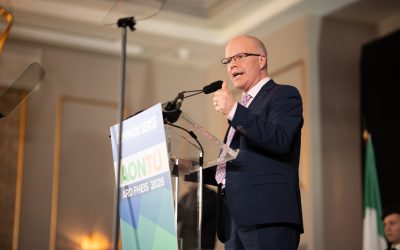
The Aontú leader, Meath West TD Peadar Tóibín, has told the Dáil that radiation and chemotherapy treatment targets are being missed around the country, and that people diagnosed in private hospitals are much more likely to survive cancer than those diagnosed in the public system.
Speaking today, Deputy Tóibín said:
“Where you live in Ireland is a significant determinant of whether you will survive cancer or die because of it. In Ireland today, post codes should have government health warnings. When there is a cancer diagnosis in a family a dark cloud descends on everyone. While treatment success rates rightly give many people hope, there is no doubt that for serious cancers, every waking moment can be consumed with whether you will make it. The Irish Cancer Society today has released damning information that shows significant variations with regards access to cancer diagnostics and treatments. Timely Life-saving chemotherapy and radiotherapy treatments are being denied for patients referred for urgent breast and prostate tests. Chemotherapy should start within 15 working days of being prescribed. On Monday I met doctors in Letterkenny who told me that just 12% of cancer patients at the hospital received treatment within the recommended 15-working-day timeframe”.
Deputy Tóibín continued: “In Galway patients are waiting seven to eight weeks for treatment. The National Cancer Control Programme has written to Aontú to say that the HSE is failing to meet their own radiation treatment targets. In the year to August 24, treatment targets were met once in Galway and only twice in Cork. Cancer services on the northwest coast being shut down. Cancer centres in Galway, Waterford and Limerick do not have the necessary PET scanners. Antique Radiotherapy equipment is breaking down”.
“I have had cancer Taoiseach. I know what’s it’s like to have cancer growing within you. All you want to do is cut it out or zap it with chemo as fast as you can. Delayed treatment means radically worse results. Delayed treatment will mean the cancer can spread to other parts of your body. People are dying in this country for the want of timely treatment. The Irish Cancer Society has said that your government has met only one, of the six targets set for cancer tests and treatment. Aontú has discovered that there is a 12% differential in breast cancer survival rates when we compare women diagnosed in public hospitals or private hospitals in this country. Women diagnosed with breast cancer in a designated cancer centre have an 85% chance of surviving five years, those diagnosed in “other public hospitals” have an 81% chance of surviving, while those diagnosed in a private hospital have a 93% survival chance. If you’re diagnosed with breast cancer in Sweden you are 7% more likely to survive than if You’re diagnosed in Ireland. In Britain you are 5% more likely to survive. Taoiseach when will you stop dividing cancer patients on the basis of post codes and income? When will citizens have equal access to life saving treatment?” concluded Tóibín.
CRIOCH
087 270 79 85
______________________________________________
For Written Answer on : 12/10/2021
Question Number(s): 620 Question Reference(s): 49706/21
Department: Health
Asked by: Peadar Tóibín T.D.
______________________________________________
QUESTION
To ask the Minister for Health if the attention of his Department has been drawn to any differential in survival rates for breast cancer between patients who are diagnosed and treated in the public system and those diagnosed and treated in the private system; and if he will provide the statistics on the issue.
REPLY
The Department of Health is not aware of any recent report in regard to a differential in survival rates for breast cancer between patients who are diagnosed and treated in the public system and those diagnosed and treated in the private system.
A National Cancer Registry Ireland (NCRI) report “Cancer care and survival in relation to centralisation of Irish cancer services: an analysis of National Cancer Registry data 1994-2015”, published in 2019, sets out that from 2008-2014, 5-year survival by category of hospital was as follows:
|
|
Designated cancer centres |
Other public hospitals |
Private hospitals |
|
5-year survival, 2008-2014 |
85% |
81% |
93% |
There are a number of points to be consider in relation to this data, including that:
- The majority of all breast cancer cases were diagnosed or treated in designated cancer centres (70%), with the balance in either other public hospitals or in private hospitals. The proportion of breast cancer patients in private hospitals was relatively small.
- Patients can transition in and out of the public system, and between hospitals within the public system. Status may vary for individual patients at different points in their diagnosis and treatment pathway.
- The figures are not adjusted for cancer stage, or for the age of patients.
NCRI data shows that five-year net survival for breast cancer improved markedly from an average of 70% for diagnosis period 1994-1999, to 85% for 2011-2015.
The study referenced above predates the commencement of the National Cancer Strategy 2017-2026. Further improvements in breast cancer survival rates are to be expected over the lifetime of the Strategy.
As part of Budget 2021, an extra €20m has been allocated for the continued implementation of the National Cancer Strategy this year. Additional funding of €12m has also been allocated in 2021 for the restoration of cancer services in the context of the Covid 19 pandemic.