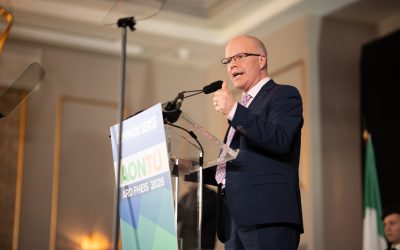
Aontú submits petition to Government showing EU Migration Pact that comes into force today “does not have public support”.
The party’s politicians unite in saying the pact is “a big mistake” for Ireland, will take away our ability to make key decisions on migration and does not suit us geographically or politically.
Aontú leader Peadar Tóibín says that from today, Ireland no longer has power to make decisions for itself on migration, with the commencement of the EU Migration Pact
He said the strength of public opposition to this is such that an Aontú petition against it attracted 60,000 signatures in a few days.
Said Tóibín “We sent the Taoiseach a copy of a petition that has been signed by over 60,000 Irish citizens. It demands that the government does not participate in the EU Migration Pact. The EU migration pact is bad for Ireland. It does not have public support.
“It outsources decisions on costs and numbers coming here, and locks us into them. It fails to account for our open border with the north.”
Aontú TD for Mayo Paul Lawless said: “Ireland had an opt-out in relation to this. And in 20204, the government opted in. It does not recognise that Ireland has a unique place in Europe, geographically and due to the Common Travel Area.
“It has sold this on positives such as processing times and co-ordination, but all of those things could have been achieved prior to the pact. We did not need to sign into it and hand over Irish decisions to Brussels.”
The party’s senator Sarah O’Reilly highlighted: “The Irish people had no say whether they entered into this pact. We should make decisions on migration policy, not the EU.
“I remain concerned that through the pact, we have transferred significant elements of our decision making. The practical effect is Ireland has reduced autonomy in determining how its immigration system operates.
“Governments often argue they have a democratic mandate. But were voters explicitly told immigration policy would increasingly be shaped through EU level mechanisms?